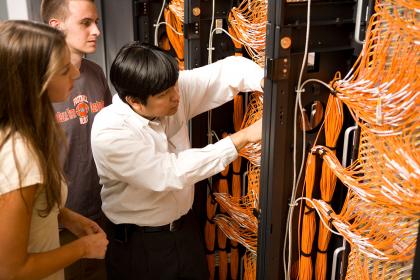
This project, a subaward from the University of Michigan, compares broadband development processes and outcomes across three leading domestic broadband initiatives: the federal government’s Broadband Technology Opportunities Program (BTOP) and Broadband Initiatives Program (BIP), and the experimental Google Fiber initiative. Working closely with the sponsoring organizations and a subset of project grantees, our study deploys a combination of ethnographic, survey-based, network analytic, and statistical methods to address three central questions:
What role do existing community resources and networks play in efforts to mobilize, secure funding for, and deploy high-speed broadband infrastructure?
What new or extended forms of social interaction are supported by high-speed...
Current Projects
Current research projects are listed alphabetically by project title.
Funding
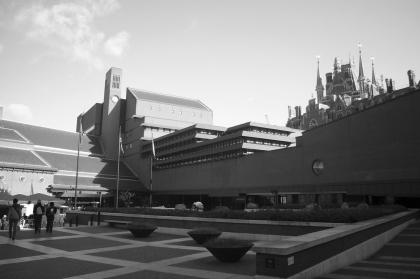
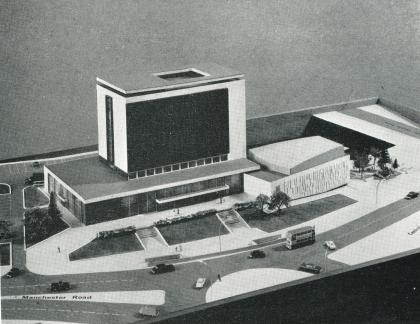
Ford Foundation — $108,000Against the backdrop of a powerful desire for national modernization, the Long 1960s (c. 1955-1975) witnessed attempts to build, literally, a better post-war Britain. The unprecedented burst of building activity that marked the post-war years included the planning and construction of hundreds of public library buildings, clothed in a variety of modernist styles symbolic of the period's spirit of renewal. Described at the time as a "national health service for reading," public libraries assumed a prominent position in the post-war welfare state. Through analysis of extant buildings and primary source documents, the research will examine what modernist library design meant to librarians, architects, local politicians and planners, and the public. The research will contribute...
Funding
University of Illinois Research Board — $4,250“Scientific collections created and used in basic research are an integral part of the nation’s scientific infrastructure. They hold specimens of plants, animals, microbes, fossils, minerals and other artifacts that together comprise a national legacy of biological diversity”. (NSF Scientific Collections Survey, 2009). Individual specimens in these collections serve as the anchor for an expanding array of information that grows and changes with time about the specimen and the group that the specimen represents. Unfortunately, specimens and subsamples are scattered geographically across institutions. Taxonomic, genomic, geospatial, and other information about the specimens are also scattered across independent computer systems and on paper and are very difficult to access or synthesize...
Funding
National Science Foundation — $35,581This project develops a freely available database that links Medline papers and U.S. patents, through identification of individuals who authored both papers and patents and analysis of citations between papers and patents. These patent-paper-author links will then enable identification of similar organizations and in some cases, science/technology field and geography. Co-authorship networks for scientists are also prepared, annotated and made available on the Dataverse Network System (DVN), analogously to what has been done for inventors in the patent record (NSF proposal 0830287). This integrated database enables researchers to investigate how 1) grants enable papers, 2) papers influence patenting, and 3) scientific knowledge ultimately diffuses and influences the entire patent record...
Funding
National Science Foundation — $445,165Andrew W. Mellon Foundation — $10,000
The Data Conservancy is a $20 million initiative led by Sayeed Choudhury at the Johns Hopkins University Sheridan Libraries. The three-year award, one of the first two in the NSF’s DataNet program, is building infrastructure for the management of the ever-increasing amounts of digital research data. The CIRSS team will receive approximately $1.19 million for their contributions to multiple aspects of the project. The Data Practices team (Palmer, Cragin, MacMullen, & Chao) is investigating expectations and requirements across the scientific communities served by Data Conservancy, establishing criteria...
Funding
National Science Foundation — $1,190,000The goal of Data Curation Education in Research Centers (DCERC) is to develop a sustainable and transferable model for educating Library and Information Science (LIS) masters and doctoral students in data curation through field experiences in research and data centers. DCERC will establish and implement a graduate research and education program in scientific data curation that will bring students into the real world of scientific data curation, where they will engage with current practices and challenges, and share their developing expertise and research in the area. The program builds on the well-...
Funding
Institute of Museum and Library Services — $988,543As efforts to integrate and federate digital resources proceed apace, we are learning more about the problems that emerge at different levels of scale and granularity. Building on prior work of the Digital Collections and Content project (DCC), we will investigate and implement a systematic approach that confronts these problems and offers robust means for adding value and improving access to existing digital aggregations.
...Funding
Institute of Museum and Library Services — $1,779,000The Digital Collections and Content (DCC) project is a multi-phase research effort funded by IMLS to explore the socio-technical requirements for a successful digital aggregation. Conceived in 2002 as a combined collection registry and metadata repository aimed to provide a single access point to collections built from digitization efforts funded through IMLS's National Leadership Grant and LSTA programs, the IMLS DCC project explored key digital libraries issues ranging from collaboration stakeholder needs to metadata quality and interoperability.
Beginning in 2007, the second phase of the IMLS DCC project, through the DCC project's Opening History aggregation, which gathered together digital collections of digitized and born-digital U.S. cultural heritage resources,...
Funding
Institute of Museum and Library Services — $1,779,000The Center for Informatics Research in Science and Scholarship at the University of Illinois will collaborate with the Maryland Institute for Technology in the Humanities at the University of Maryland and the Center for Digital Scholarship at Brown University to develop and conduct a series of advanced institutes on data curation for the digital humanities, to be held at the University of Illinois, Urbana-Champaign (Graduate School of Library and Information Science), the University of Maryland (Maryland Institute for Technology in the Humanities) and at Brown University (Center for Digital Scholarship).
Funding
National Endowment for the Humanities — $144,855The IMLS Digital Collections & Content (DCC) team has received a $50,000 sub-award from the Digital Public Library of America’s (DPLA) Secretariat to further refine the team’s DPLA Beta Sprint prototype. The Beta Sprint prototype was originally developed during Summer 2011 as part of the DPLA Beta Sprint. The prototype was selected as one of six finalist projects showcased during the DPLA’s Fall 2011 Plenary Meeting in Washington, D.C.
Bringing together resources from over 1000 cultural heritage collections across the U.S., the prototype builds on the Digital Collections and Content, developed with funding from the Institute of Museum and Library Services, and the team’s knowledge and experiences aggregating metadata records from varied institutions ranging from...
This project proposes to use supervised machine learning to build an entity extractor that is specifically designed for supporting the constructing of socio-technical network data. The resulting probabilistic prediction models and end-user technology are essential for being able to address substantive questions about real-world networks. The project team will make these outcomes publicly available to enable others to perform text coding projects, especially in the social sciences and humanities. We will also apply this extractor to multiple corpora for research projects.
Funding
Extreme Science and Engineering Discovery EnvironmentField experience has long been recognized as a critical component of Library and Information Science (LIS) education. While on-the-ground experience and anecdotal evidence about the strengths and weaknesses of field experience programs abound, the LIS field lacks the research found in complementary fields such as education and nursing that is required to identify and promote “best practices” for this important component of LIS education. Field Strength, a project to be led by the University Library at the University of Illinois at Urbana-Champaign in collaboration with the Graduate School of Library and Information Science, will begin to identify best practices in field experience in LIS education. The iSchools and University Libraries at the University of Maryland and...
Funding
Institute of Museum and Library Services — $49,989An archivally grounded research project on telecommunications system development between the 1870s and the 1970s.
...
Mak's book, "How the Page Matters," historicizes recent debates about eBooks and similar technologies by casting the page as an interface that has been under development since the scrolls of Antiquity. "How the Page Matters" tracks the page through the manuscripts of the Middle Ages, the printed books of the early modern period, and onto digital displays. By locating the page in a broader tradition of writing technologies, the book re-examines the print and digital 'revolutions' and shows that the questions raised by digital theorists about the visualization of information are not new, but are instead the persistent issues in a long history of graphic reproduction. "How the Page Matters" contends that the material of the page is constitutive of knowledge; the...
Funding
University of Illinois Research Board — $9,000Notably absent in the current rush to digitize newspapers and books are critical investigations of the processes and products of this work. Such examinations are forestalled, Mak argues, by a rhetoric of revolution that determines how the phenomenon should be constituted and studied, just as it continues to do for the so-called printing revolution of the fifteenth century. Her analysis of digitizations exposes the ways in which historical sources are being reconfigured for digital transmission as part of the “information revolution,” and considers the consequences of this reconfiguration for humanities scholarship, cultural heritage, and the making of meaning.
Funding
Illinois Program for Research in the Humanities — $14,000Inclusive Gigabit Libraries: Learn, Discuss and Brainstorm consists of an educational campaign to raise awareness of next generation networks and how libraries might participate in U.S. Ignite-related initiatives; at least six national forums for about 150 library leaders; development of at least five case studies; and a white paper that will synthesize the forums and case studies.
The primary goal of the US Ignite Partnership will be to catalyze approximately 60 advanced, next-generation applications over the next five years in six areas of national priority: education and workforce development, advanced manufacturing, health, transportation, public safety, and clean energy.
The white paper will assess the governance, staff and financial resources and capabilities...
Funding
Institute of Museum and Library Services — $99,168Library Access Midwest Program, also known as LAMP was launched in 2006 to address a severe regional shortage of library and information science (LIS) professionals from underrepresented groups. With support from IMLS, Midwestern LIS leaders have been successful in designing and piloting a model to promote LIS careers, with special emphasis on recruitment and retention of students from statistically and historically underrepresented populations. LAMP II will build on these initial achievements.
Funding
Institute of Museum and Library Services — $826,502In order for older texts to be searchable, contemporary English needs to be translated into language from various historical timeframes. The project will develop software that will let people enter a query in contemporary English, and search over English texts throughout history—from Medieval times to the present day. The project will mostly involve training statistical models that assign probabilities of the translation to a word or phrase in a target English language. The project will also look at how to display results in order to provide the user with the most probable answer to the query.
...Funding
Google — $49,429Microblogging services like Twitter are becoming an important part of how many people manage information in their day to day activities. As microblog traffic increases (Twitter currently sees about 50 million tweets per day) information management and organization will become keen problems in this area. The project will define the core problems in microblog search and propose solutions to these challenges in the form of both theoretical models and prototype search systems.
...Funding
Google — $45,563Google — $22,714
Mix IT Up! Youth Advocacy Librarianship focuses on creating intentionally structured, youth-centered, engaged learning opportunities related to information technologies. Mix IT Up! enhances youth services by developing a library and information science (LIS) specialization that dovetails with community informatics and youth service in order to focus on systematically training librarians as youth advocates. Mix IT Up! actively recruits youth advocacy fellows from traditionally underrepresented groups in LIS - American Indian, Latino/a, African American, and working class - by providing academic and financial support. Fellows are placed in long-term youth advocacy projects that partner with community organizations serving youth. Fellows also engage with selected community...
Funding
Institute of Museum and Library Services — $904,314This project assesses an American Library Association (ALA) “News Know-how” program, which engages librarians, journalists, news ethicists and students across the country in news literacy education.
The evaluation will provide information that will help the ALA and its partners adjust the strategy for delivering this program as well as provide a final evaluation of the overall impact of the program. The evaluation addresses the following questions:
- What impact does the News Know-how program have on educating the participants about news literacy? To what extent do participants apply and use news literacy skills in their daily lives? How well are the students able to apply the library profession’s information literacy principles to analyzing and thinking critically...
Funding
American Library Association — $89,697This project will investigate and implement a systematic approach to developing useful, meaningful, and usable digital collections. Building on the prior work of the IMLS Digital Collections and Content (DCC) project, the researchers will explore how to use the relationships between collection-level and item-level metadata in federated digital repositories to preserve content and make the content more useful for scholars and the public. The project will experiment with and test metasearch capabilities, and expand and improve the IMLS DCC with new IMLS-funded and other digital content and advanced search...
Funding
Institute of Museum and Library Services — $975,903The overarching goals of the Open Annotation Collaboration (OAC) are to facilitate to emergence of a Web and resource-centric interoperable annotation environment that allows leveraging annotations across the boundaries of annotation clients, annotation servers, and content collections, to demonstrate the utility of this environment, and to see widespread adoption of this environment. To this end the OAC has made available the draft annotation data model and ontology developed during Phase I. OAC Phase II focuses on directly engaging humanities scholars and involving existing collections of digital...
Funding
Andrew W. Mellon Foundation — $362,000Andrew W. Mellon Foundation — $170,000
This project will enhance the GSLIS doctoral program by building a stronger research community within the school for the study of information in society, including policy, economic, and historical dimensions. Project goals include enhancing the doctoral program curriculum; connecting the research community to the wider world of librarianship; and attracting and supporting thirteen diverse students, especially those from underrepresented groups, with a specific focus on recruiting doctoral students who will teach master's students capable of becoming future leaders in public, academic, and school libraries.
Funding
Institute of Museum and Library Services — $990,234The original Preserving Virtual Worlds project, funded by the Library of Congress’s National Digital Information Infrastructure and Preservation Program (NDIIP), investigated what preservation issues arose with computer games and interactive fiction, and how existing metadata and packaging standards might be employed for the long-term preservation of these materials. PVW2 will focus on determining properties for a variety of educational games and game franchises in order to provide a set of best practices for preserving the materials through virtualization technologies and migration, as well as provide an...
Funding
Institute of Museum and Library Services — $785,898Structural analysis of music (formal analysis) is one of the most fundamental analyses performed by music researchers, usually preceding any other types of analysis because it provides the overall view of the piece. Its importance is reflected by the fact that the course on formal analysis is often one of the core music undergraduate music curricula with several major textbooks on the subject. The main goal of formal analysis is to find similar sections within a piece of music and labeling these section such as, ABA and ABCB'A or with further analysis these sections can be marked with predefined labels such as Intro, Verse, Verse, Bridge, Chorus, Verse, and Outro (popular music) or Introduction, Exposition, Development, Recapitulation, and Coda (sonata form). Thus, the...
Funding
National Science Foundation — $99,476Eight scholarships will be offered over three years to outstanding and diverse students admitted to the Certificate of Advanced Studies (CAS) program. This program will provide continuing education by offering outstanding library practitioners the opportunity to continue their education in a topic related to youth services, and by providing institutional support for these students to develop continuing education workshops for others. The two central goals of this project are: 1) leaders in the youth services library profession will provide quality continuing education for their practitioner peers in...
Funding
Institute of Museum and Library Services — $364,925The Site-Based Data Curation (SBDC) project is a two-year effort to develop a framework of policies and processes for the curation of “site-based” digital research data that responds to the needs of long-tail science researchers and site managers, and promotes coordination with libraries and data repositories. The SBDC framework will be developed by experts in data curation, research library repositories, domain science, and research site management, providing a curation model that includes: 1) policies to infuse principled curation practices early in the data lifecycle; and 2) processes for curating cohesive aggregations of usable digital data for transfer from research sites to libraries and repositories. The SBDC framework is an important step forward in evolving the professional...
Funding
Institute of Museum and Library Services — $499,919Films are produced, screened and perceived as part of a larger and continuously changing ecosystem that involves multiple stakeholders and themes. This project will measure the impact of social justice documentaries by capturing, modeling and analyzing the map of these stakeholders and themes in a systematic, scalable and analytically rigorous fashion. This solution will result in a validated, re-useable and end-user friendly methodology and technology that practitioners can use to assess the long-term impact of media productions beyond the number of people who have seen a screening or visited a webpage. Moreover, bringing the proposed computational methodology into a real-world application context can serve as a case-study for demonstrating the usability of this cutting-edge solution...
Funding
Ford Foundation — $150,000This project will create both a master’s and doctoral-level specialization in Sociotechnical Data Analytics (SODA). Partnerships with local researchers and businesses who already work with large data-sets will enable MS graduates to receive first-hand experience with both the social and technical implications of large digital data collections, and thus be well-prepared for leadership roles in academic and corporate environments. Similarly, doctoral students will consider multiple stages of the information lifecycle, which will help to ensure that their research findings will generalize to a range of...
Funding
Institute of Museum and Library Services — $498,777SEASR, subawarded through Stanford University, fosters collaboration by empowering scholars to share data and research in virtual work environments. This eases scholars’ access to digital research materials, which currently are stored in a variety of incompatible formats.
Funding
Andrew W. Mellon Foundation — $359,860The Sowing Seeds project will establish a new community technology center (CTC) in Danville, Illinois, and expand basic training to this and four existing CTCs in Champaign-Urbana and East St. Louis, Iliinois. Basic skills are just the gateway, however. The grant will allow for expansion of our advanced digital media training focused on the development of skills necessary to meet the NETS standards of the International Society for Technology in Education (ISTE).
Funding
Illinois Department of Commerce & Economic Opportunity — $116,457The goal of this research study is to examine the social and economic impact of the Urbana-Champaign Big Broadband (“UC2B”) project. The funding will support the analysis and reporting of the social and economic impact of the adoption of broadband services provided by the UC2B program and the development of a data archive to organize all of the data used to perform the analysis and reporting.
Funding
Partnership for a Connected Illinois — $57,009Time affects information retrieval in many ways. Collections of documents change as new items are indexed. The content of documents themselves may change. Users submit queries at particular moments in time. And perhaps most importantly, people’s assessment of a document’s relevance to a query is often time-dependent. For example, searchers of news archives might seek information on a past event where relevant documents cluster in a window of time. Users of social media services such as Twitter demand topically relevant information that is new. People who monitor particular topics in the news (for example, editors of Wikipedia) take action when they find information that is topically relevant and that changes current knowledge. The traces of information created by change in documents,...
Funding
National Science Foundation — $408,908Vast quantities of electronic information provide a unique opportunity for scientists to identify candidate solutions for grand challenges as scientists, policy makers, and students have never had access to more electronic information than they do today. The goal in this research is to develop new text mining methods that are consistent with the manual processes that experts currently used to resolve contradictory and redundant evidence. Both discovery and synthesis are difficult activities even for people, so a socio-technical strategy will be required to achieve this goal.
...
Funding
National Science Foundation — $449,317For over two millennia, librarians have played a critical role in the production and transmission of knowledge. They have helped to collect, catalogue, and curate a vast range of materials that constitute much of our cultural heritage - from epic poetry on papyrus scrolls to PDFs of scholarly articles. This project interrogates these practices by building a librarian's cabinet of curiosity, and populating it with explicit examples of the mundane activities that occur in and around the library.
Funding
University of Illinois Research Board — $6,500Jon Gant directs a canvassing operation and research team to assess and evaluate the implementation, progress and overall adoption success of the UC2B project. Researchers hope to deepen the understanding of the barriers to broadband adoption among residents of underserved communities. Gant's team has been integral to identifying households that are eligible for free installation, and then working with city agencies and local businesses to connect the households to fiber-optic broadband service. The Broadband Operations project has experience across the digital spectrum, from those completely unfamiliar with digital applications, to others who utilize the Internet for education, entertainment, employment, or citizen activism, among a range of choices. The adoption team is on the...